Anarres–Urras political isolation
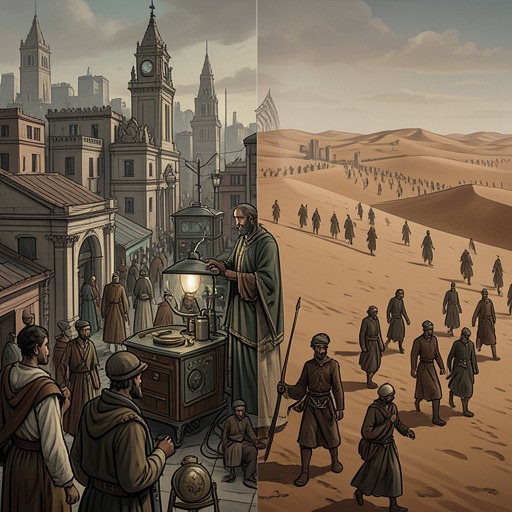
The DispossessedAnarres–Urras political isolation is the network of restrictions that keeps the two inhabited worlds apart while allowing carefully controlled contact between them. It shapes who may travel, what may cross the boundary, and who can control communication and scientific exchange. The separation is not simply a distance between planets: for Shevek, it becomes a lived conflict between Anarres’s ethic of sharing and Urras’s systems of money, state authority, and ownership, and the political question of whether knowledge can pass between worlds without becoming an instrument of power.
Boundaries and Controlled Contact
Contact is possible, but it is neither open nor politically neutral. On Anarres, the research institute’s route for sending work to Urras depends on a mail slot aboard the Urrasti freighters. The slot is vulnerable to political pressure: Defense requires material leaving on the ships to be reviewed by a PDC-approved expert, while physicists outside the favored channel resent the Institute’s access. Its retention is tied to Pegvur’s election to the PDC a decade earlier and to the careful maneuvering of those who control it. Scientific communication therefore depends on a scarce institutional opening, not on a general freedom to exchange ideas.
The boundary also shapes the conditions of Shevek’s arrival. He comes to Urras without money and without gifts, because Anarresti do not use money and he cannot bring enough necessities to live independently. He describes himself as the Beggarman: if his hosts keep him alive, they must give him what he needs rather than sell it to him. Later, when Atro and Pae arrange clothing and other small necessities, he again presents himself as arriving with empty hands. These encounters make the political divide concrete in everyday dependence: a visitor from a world organized around non-ownership enters a society in which he has no means to buy his own place.
Shevek’s Bargain and the Wall Around Him
Shevek does not mistake hospitality for unrestricted solidarity. He tells Chifoilisk that he came to bargain with Urras, seeking to end his people’s exile and to establish free exchange between Urras and Anarres. He believes A-Io fears him less than Thu would, because A-Io has forgotten the revolution and assumes that material possession can make people content within confinement. His aim, as he puts it, is to bring the walls down; his scientific work is entangled with that political purpose because the Urrasti want what he knows.
An unsigned letter forces him to see the cost of acting within the arrangement. Hidden in the pocket of a new coat, it asks whether he has come to bring the Odonian hope or is instead betraying his world by working with the power system. The appeal jolts him because he has not met the poor people of Urras: protected by the smiles of the rich, he has accepted shelter without noticing the wall built around him. He recognizes that he has been co-opted, yet cannot see how to get beyond his enclosure or whom he could trust. The political separation thus works not only by keeping worlds apart, but by channeling a visitor’s contact with one world through its privileged institutions and people.
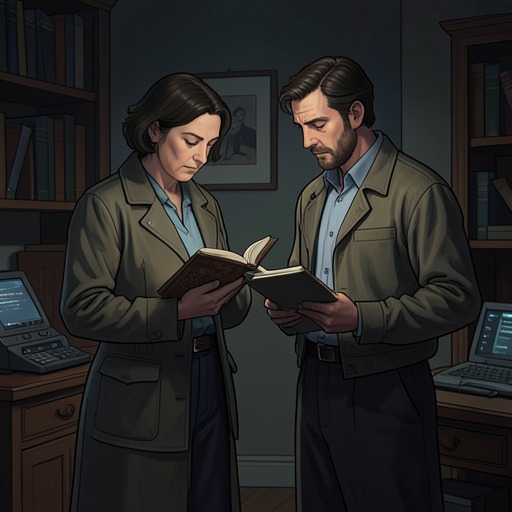
The letter’s challenge changes how Shevek handles his work. With the Benbili revolution sharpening his doubts about his silence, he finds himself having to distrust people he has been accustomed to regard as potential helpers. He keeps his working notes on his body, carries them in the pockets of his Urrasti clothes, and clears his desk computer rather than leaving his work exposed. He knows the Ioti want the General Temporal Theory for spaceflight and prestige, but also knows he has not completed it and may never do so. In this setting, control of knowledge is a form of bargaining power, while the possibility of sharing it freely remains inseparable from the question of who might use it.
War, Authority, and Public Speech
The isolation is reinforced by the state’s ability to restrict ordinary freedoms under the declared condition of war. When A-Io is officially at war with Thu, research at the College of Noble Science is subject to classification, publication may be delayed if officials consider a paper dangerous or incomprehensible, and non-nationals such as Shevek are not supposed to leave campus without the Chancellor’s clearance. The regulations can be presented as tiresome formalities, and officials may claim to be able to evade them, but their existence makes movement and communication depend on state permission.
The violence of the Nio Esseia demonstration shows what this authority can do to public contact within Urras itself. In Capitol Square, a vast crowd gathers, marches, and listens to speakers; Shevek speaks among them, describing shared suffering and the need for people to reach out to one another. The crowd’s mass presence briefly makes solidarity publicly visible, but police helicopters drown out his voice and fire on those nearest the Directorate steps. People are driven toward the exits and into the building for shelter; soldiers enter among the dead and wounded. The word “DOWN” is left in blood on the foyer wall. The scene makes the separation’s political logic stark: official order can permit controlled exchanges while suppressing collective action that might turn solidarity into a force of its own.
A Gift Across the Divide
At the Terran embassy, Shevek finds a different legal framing of the boundary. Keng explains that the embassy belongs to the Council of World Governments rather than to A-Io, and that the castle is regarded as Terran soil. The diplomatic fiction makes it possible for Shevek to be there and for the embassy to assert his right to enter, even though it stands in Rodarred, on Urras, far from Terra. The exchange reveals that borders and jurisdiction are not merely physical facts: institutions can define a space’s political status and use that definition to shelter someone whom the host state might otherwise control.
Shevek’s final challenge is directed at the terms of exchange themselves. He asks whether selling is the only alternative and whether a gift is possible. He wants to give his theory not only to Keng but to Hain and the other worlds, and to the countries of Urras, so that no single power can use it to dominate rivals, grow richer, or win wars. He refuses to wait for truth eventually to serve the common good: he has one lifetime and will not spend it serving greed, profiteering, or lies. The gift is therefore more than a gesture of generosity. It is his proposed way to open communication across the political divide without allowing one state or institution to claim the knowledge as private property.
The isolation remains tangible at Anarres’s port. The Terms of the Closure of the Settlement state that nobody may leave the freight ships beyond the boundary of the Port of Anarres. When the question arises whether Shevek can return, Rulag invokes that restriction; Bedap challenges its application, while an adviser suggests it was meant for Urrasti. Rulag’s response—that a person coming from Urras is Urrasti—shows how the rule can turn political separation into a test of identity and admission. The boundary that Shevek wants to open is therefore enforced at both ends: by Urras’s control over movement and exchange, and by Anarres’s formal restriction on who may come ashore.
Significance
The separation between the worlds produces a structural contrast rather than a simple opposition between contact and isolation. Urras can welcome Shevek as a celebrated scientist while enclosing him among the wealthy, regulating his movement, and seeking the value of his research. Anarres can embody sharing while maintaining a port boundary that limits return and entry. Neither world’s rules disappear when the other is approached; instead, each makes its principles visible through the conditions it sets on access.
Against those limits, the novel connects political freedom to forms of exchange that cannot be reduced to purchase or permission. Shevek’s empty hands expose his dependence on Urrasti generosity, while his eventual offer of theory as a gift turns that dependence into a political question: whether what is learned on one world can become common across worlds. The isolation is consequential precisely because it makes that question unavoidable. To bring the wall down requires more than travel or a mail route; it requires changing who controls the passage of people, speech, and knowledge.